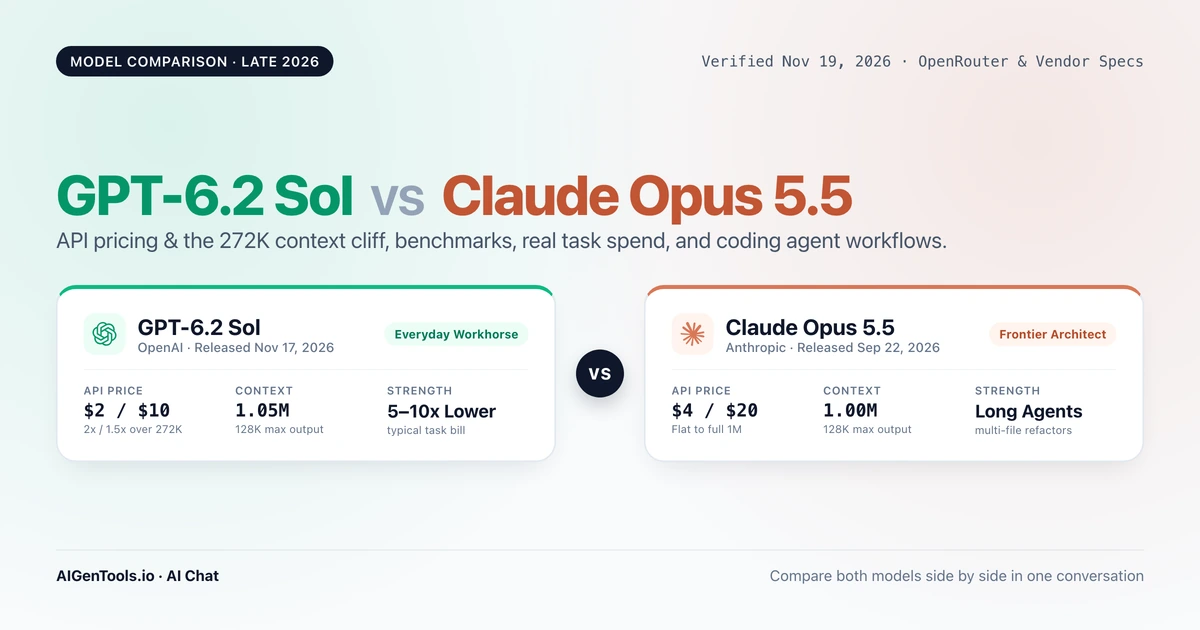
If your prompts stay under 272K tokens and you're doing everyday coding, PR reviews, or data work, GPT-6.2 Sol is the easier default. Its base API rate ($2/$10 per million tokens) is half of Claude Opus 5.5's, and because Sol writes shorter answers, real multi-step runs often end up 5x to 10x cheaper. If you're refactoring across a whole codebase, running a coding agent for half an hour straight, writing long technical specs, or sending prompts past 272K tokens, Claude Opus 5.5 still holds up better and keeps flat $4/$20 pricing all the way to 1 million tokens.
On paper, this isn't even a same-tier matchup. OpenAI shipped GPT-6.2 Sol on November 17, 2026 as the middle model under GPT-6.2 Astra ($8/$40). Anthropic shipped Claude Opus 5.5 on September 22, 2026 as its top model above Claude Sonnet 5.5 ($2/$10). People keep putting Sol next to Opus 5.5 anyway because Sol gets within a couple of points of flagship scores while costing half as much per token.
Every spec, price, and benchmark below was checked on November 19, 2026 against OpenAI's release notes, Anthropic's model docs, and live API listings. Want to see the difference on your own prompts? Both GPT-6.2 Sol and Claude Opus 5.5 are live in AI Chat, and you can switch between them inside the same thread.
Which one should you pick?
The short version: run GPT-6.2 Sol for routine, well-defined work, and pull in Claude Opus 5.5 when the job is messy, spans lots of files, or crosses 272K input tokens.
| What you're doing | Pick first | Why |
|---|---|---|
| Everyday coding, clear tickets, unit tests | GPT-6.2 Sol | Faster replies, shorter diffs, and a much smaller bill per ticket. |
| Automated PR reviews and CI checks | GPT-6.2 Sol | Good at catching real edge-case bugs without burning huge output budgets. |
| Large refactors or repo-wide migrations | Claude Opus 5.5 | Less likely to drop constraints across files or cut corners. |
| Long coding agents (30+ minutes) | Claude Opus 5.5 | Holds its plan over long tool-calling loops with less babysitting. |
| Single prompts over 272K input tokens | Claude Opus 5.5 | Flat $4/$20 rates up to 1M tokens avoid OpenAI's 2x input and 1.5x output jump. |
| SQL, data analysis, strict JSON | GPT-6.2 Sol | Hit ~93% on Plotly's analytics suite with a ~10.5-second median run time. |
| PRDs, post-mortems, long-form writing | Claude Opus 5.5 | Reads like a human edited it; fewer robotic bullet lists. |
Specs and API pricing side by side
Most of the headline numbers look almost identical: roughly a 1M context window, 128K max output, text/image/file inputs, and reasoning turned on by default. What actually changes your bill and your workflow is the 272K pricing jump on Sol and how long Opus 5.5 thinks before answering.
| Specification | GPT-6.2 Sol (OpenAI) | Claude Opus 5.5 (Anthropic) |
|---|---|---|
| Release date | November 17, 2026 | September 22, 2026 |
| API model ID | gpt-6.2-sol | claude-opus-5-5 |
| Place in lineup | Everyday model (below GPT-6.2 Astra) | Top model (above Claude Sonnet 5.5) |
| Context window | 1,050,000 tokens (1.05M) | 1,000,000 tokens (1M) |
| Max output tokens | 128,000 tokens | 128,000 tokens |
| Knowledge cutoff | June 1, 2026 | June 2026 |
| Input types | Text, image, file | Text, image, file |
| Standard input price | $2.00 / 1M (up to 272K) | $4.00 / 1M (flat to 1M) |
| Standard output price | $10.00 / 1M (up to 272K) | $20.00 / 1M (flat to 1M) |
| Prompt cache read | $0.10 / 1M (up to 272K) | $0.20 / 1M (flat to 1M) |
| Prompt cache write | $2.50 / 1M (up to 272K) | $5.00 / 1M (5m) / $8.00 / 1M (1h) |
| Over 272K input tokens | $4.00 in / $15.00 out / $0.20 cache (whole request) | No surcharge ($4 / $20 / $0.20) |
| Reasoning effort levels | low, medium (default), high, xhigh, max (+ ultra on select tiers) | Always-on adaptive thinking; low, medium (API default), high, xhigh, max |
| High-speed tier | Ultrafast mode (select Pro and API tiers) | Fast Mode (~2.5x speed, $8 in / $40 out) |
The real cost math: 5x to 10x cheaper under 272K, almost tied above it
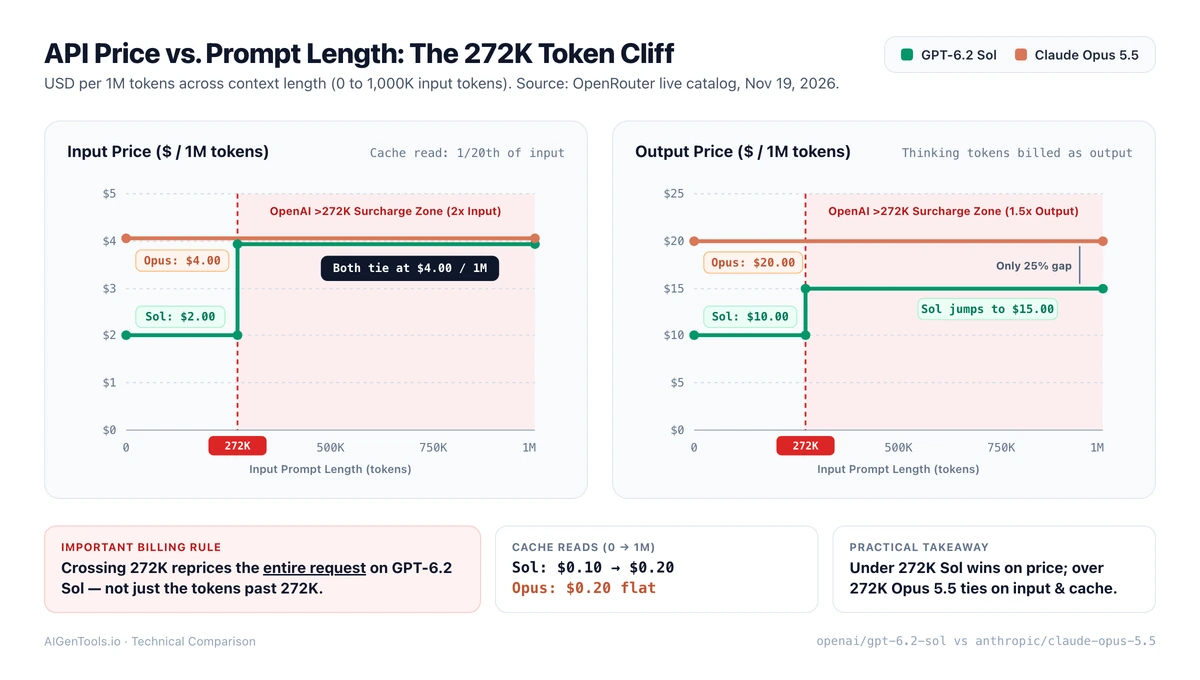
Looking only at the $2/$10 vs $4/$20 sticker prices gives you the wrong intuition in both directions. On normal prompts, Sol ends up much more than 2x cheaper. On huge prompts, OpenAI's long-context tier wipes out the input price gap completely.
Why short prompts cost 5x to 10x more on Opus 5.5
With reasoning models, output tokens drive most of the bill because internal thinking counts as output. OpenAI tuned the GPT-6.2 models to use fewer output tokens and stop as soon as the job is done. Claude Opus 5.5 does the opposite: its adaptive thinking runs longer checks and writes fuller explanations. On the same multi-step test suites, independent trackers routinely see Opus 5.5 emit 2.5x to 3.5x more output tokens than GPT-6.2 Sol.
Stack a 2x output rate ($20 vs $10) on top of roughly 3x the output tokens, and a normal multi-turn coding run costs 5x to 10x more on Opus 5.5.
The 272K pricing cliff on GPT-6.2 Sol
OpenAI sets a hard step at 272,000 input tokens across GPT-6.2. Cross that line by even a few tokens and the entire request switches to long-context rates, not just the extra tokens past 272K:
- Input doubles to $4.00 / 1M (the exact same rate as Claude Opus 5.5)
- Cache reads double to $0.20 / 1M (again, tied with Claude Opus 5.5)
- Output rises 1.5x to $15.00 / 1M (only 25% below Opus 5.5's $20.00)
Plug a real long prompt into that formula: say 400K uncached input tokens and an 8K-token answer.
- GPT-6.2 Sol:
0.4M × $4.00 + 0.008M × $15.00= $1.72 - Claude Opus 5.5:
0.4M × $4.00 + 0.008M × $20.00= $1.76
Four cents apart. If your workflow dumps a whole repository, a thick contract bundle, or massive server logs into one call, Sol stops being the budget pick and Opus 5.5 makes a lot more sense.
Benchmarks: how close is GPT-6.2 Sol to Claude Opus 5.5?
Close on general reasoning and science; a bit behind on the hardest open-ended research and long terminal tasks.
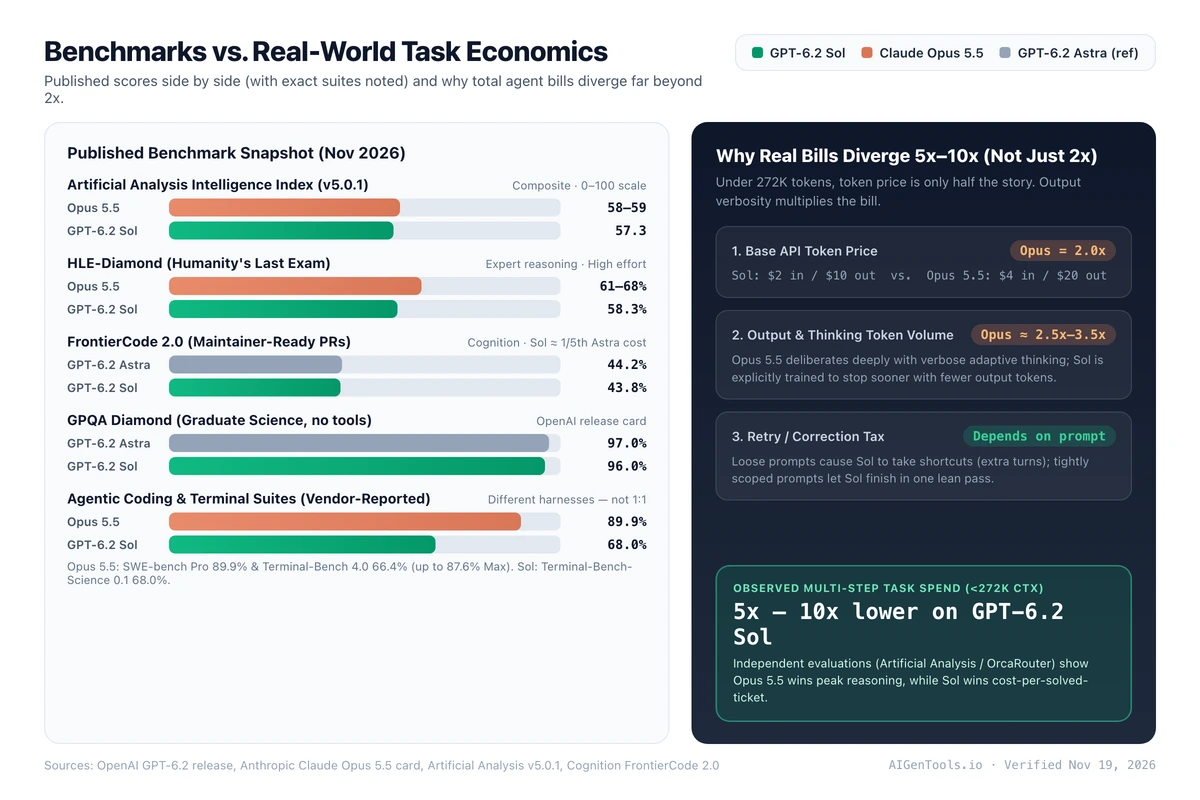
Here's where the numbers stand across public leaderboards and vendor cards:
- Artificial Analysis Intelligence Index (v5.0.1): Claude Opus 5.5 lands at 58 to 59 depending on effort settings. GPT-6.2 Sol scores 57.3, only a point or two behind at half the base token price.
- HLE-Diamond (Humanity's Last Exam): Claude Opus 5.5 scores 61.4% to 67.7% across published text subsets, ahead of GPT-6.2 Sol's 58.3% at high effort. On hard academic and cross-field questions, Opus 5.5 still has more room at the top.
- FrontierCode 2.0 (Cognition): This test checks whether an agent's PR is clean enough for a maintainer to merge as-is. GPT-6.2 Sol hits 43.8% at max effort, only 0.4 points behind OpenAI's own GPT-6.2 Astra (44.2%) while costing roughly one-fifth as much per task. Claude Opus 5.5 also sits near the top of production coding evals at High to Max effort.
- GPQA Diamond (graduate science, no tools): GPT-6.2 Sol hits 96.0% (Astra is 97.0%), right in the same upper band where Claude Opus 5.5 scores at High to Max effort.
- Coding and terminal suites: Anthropic reports 89.9% on SWE-bench Pro (up to 93.9% multilingual) and 66.4% on Terminal-Bench 4.0 (reaching 87.6% on higher-effort harnesses) for Opus 5.5. OpenAI reports 68.0% on Terminal-Bench-Science 0.1 for GPT-6.2 Sol (vs 77.1% for Astra). Those are different test harnesses, so don't read them as a direct head-to-head score.
- Knowledge work and data analytics: Opus 5.5 reaches 1846 Elo on GDPval-AA v2.1 (up from 1708 on Opus 5). GPT-6.2 Sol adds +5.3 points over GPT-6.1 Sol on GDPval v2 while cutting output length, and scores around 93% on Plotly's data analytics benchmark with a ~10.5-second median run time.
Match the effort setting before you test them
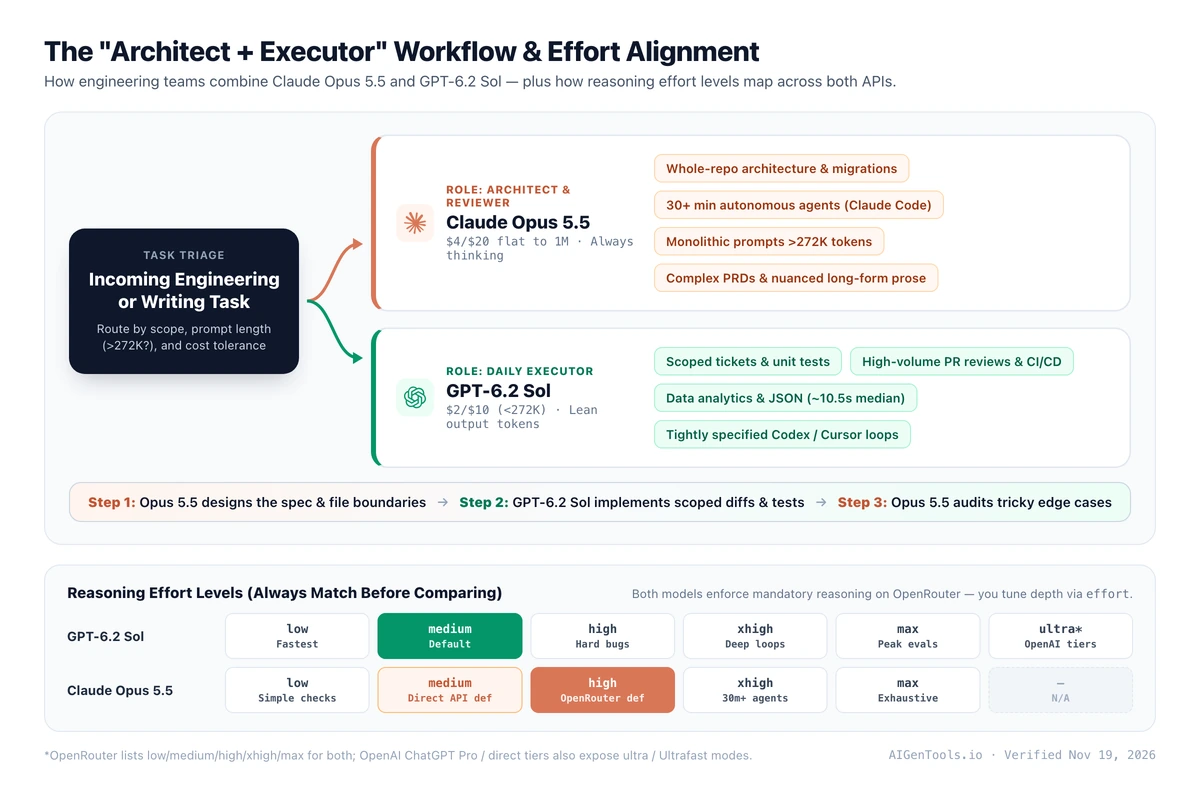
Half the conflicting reviews online come from comparing mismatched effort settings. Depending on which API or router you use, GPT-6.2 Sol defaults to medium, while Claude Opus 5.5 often runs at medium on Anthropic's direct API and high on third-party routers. Testing medium-effort Sol against high-effort Opus makes Sol look faster and sloppier than it really is at high or xhigh. Lock both models to the same effort level before calling a winner.
Coding and agent workflows (Codex, Cursor, and Claude Code)
Browse r/OpenAI, r/codex, and Hacker News and you'll see the same pattern over and over: people like GPT-6.2 Sol's speed and bill, and they still reach for Claude Opus 5.5 when a task can't afford subtle mistakes.
What GPT-6.2 Sol does well, and where it gets annoying
In an editor or CLI loop, GPT-6.2 Sol feels quick. It's strong at code reviews (catching real edge-case bugs in PRs), small-to-medium feature tickets, writing tests, and automated CI jobs where you want short, direct diffs.
The main complaint from developers is that Sol gets lazy when a prompt is vague. Hand it an open-ended request across ten files and it may skip edge cases, leave stubbed code, or touch unrelated files unless you spell out exact constraints and acceptance criteria. Give it a tight spec and it usually nails it in one pass.
When Claude Opus 5.5 is worth the slower pace
Claude Opus 5.5 is steadier when the problem is ambiguous. In Claude Code and long agent runs, its always-on thinking keeps track of cross-file dependencies and avoids breaking things three directories away. For big migrations (like porting a service or untangling a gnarly schema change), getting the design right on the first try saves more time than a cheaper token rate ever will.
For small scripts, CSS tweaks, or repetitive batch jobs, though, Opus 5.5 is overkill. You wait longer for the first token and burn more quota than the task deserves.
The two-model workflow most power users settle on
You don't have to pick one and stick with it. A lot of teams split the job into three steps:
- Plan with Claude Opus 5.5. Let it read the relevant modules, design the interfaces, call out edge cases, and write a file-by-file plan.
- Build with GPT-6.2 Sol. Feed Sol each scoped ticket with clear test cases so it writes the implementation and unit tests fast and cheap.
- Review with Claude Opus 5.5. Send the trickier diffs (auth, billing, concurrency, migrations) back to Opus 5.5 for a final sanity check.
Writing, research, and data analysis
The split shows up outside coding too.
GPT-6.2 Sol writes tight, direct answers. It likes bullet points, clean tables, and strict JSON. Pair that with its ~10.5-second median turnaround on complex analytical queries, and it's the better fit for SQL generation, dashboard analysis, structured extraction, and quick executive summaries.
Claude Opus 5.5 still writes better prose. When you're drafting a long PRD, a post-mortem, policy text, or a research write-up where flow and tone actually matter, Opus 5.5 sounds less mechanical and takes fewer rewrites to get into publishable shape.
How GPT-6.2 Sol compares to GPT-6.1 Sol, GPT-6.2 Astra, and Claude Sonnet 5.5
Both labs now split their lineups into two main tiers, so it helps to see all four models on one table:
| Model | Vendor | Base API price (in / out) | Where it fits |
|---|---|---|---|
| GPT-6.2 Sol | OpenAI | $2 / $10 (>272K: $4 / $15) | Daily workhorse; replaces GPT-6.1 Sol at the same price |
| Claude Sonnet 5.5 | Anthropic | $2 / $10 (flat to 1M) | Same-price rival to Sol; strong everyday writing and coding |
| Claude Opus 5.5 | Anthropic | $4 / $20 (flat to 1M) | Heavyweight model for deep reasoning and long agents |
| GPT-6.2 Astra | OpenAI | $8 / $40 (>272K: $16 / $60) | OpenAI's top model for research, frontend/3D, and hardest jobs |
- GPT-6.1 Sol to GPT-6.2 Sol: Straight upgrade. It came out six weeks after 6.1 Sol at the exact same $2/$10 price, adds +5.3 points on GDPval v2, catches more real bugs in code reviews, handles computer-use steps better, and trims output tokens (which makes ChatGPT Plus and Pro 5-hour caps last longer).
- GPT-6.2 Sol vs Claude Sonnet 5.5: Same $2/$10 base price. Pick Sol for fast scoped coding, analytics, and lean output; pick Sonnet 5.5 if you prefer Claude's writing style or need flat pricing past 272K tokens without paying Opus rates.
- GPT-6.2 Astra vs Claude Opus 5.5: That's the real top-tier matchup. Because Astra's base price ($8/$40) is double Opus 5.5's ($4/$20), a lot of teams test GPT-6.2 Sol against Opus 5.5 first to see how far the cheaper model gets them.
How to access both models
A lot of people went looking for GPT-6.2 Sol in their regular ChatGPT model picker on launch day and couldn't find it. Here's where each model actually lives:
- ChatGPT Free: Does not include GPT-6.2 Sol or GPT-6.2 Astra.
- ChatGPT Plus ($20/mo) and Pro ($100–$500/mo): OpenAI puts GPT-6.2 Sol inside ChatGPT Work and Codex, not the standard casual chat window. Those subscription limits also don't carry over to third-party editors like Cursor or Claude Code; calling OpenAI from external tools requires an API key and pay-as-you-go billing.
- Claude plans and cloud APIs: Claude Opus 5.5 is available on Claude Pro, Max, Team, and Enterprise, plus the Claude API, Amazon Bedrock, Google Cloud Vertex AI, and Microsoft Foundry.
- Side by side in one chat: Both GPT-6.2 Sol and Claude Opus 5.5 are available in AIGenTools AI Chat, alongside GPT-6.1 Sol, Claude Sonnet 5.5, Gemini 4 Argon, and DeepSeek. You can ask GPT-6.2 Sol to draft a solution and switch to Claude Opus 5.5 on the very next turn without re-pasting your context.
Frequently Asked Questions
Is GPT-6.2 Sol better than Claude Opus 5.5 for coding?
For routine tickets, unit tests, and automated PR reviews, yes. GPT-6.2 Sol is faster, produces cleaner short diffs, and usually costs 5x to 10x less per task. For whole-repo refactors, legacy migrations, and long autonomous coding sessions, Claude Opus 5.5 is still more dependable.
Should I switch from Claude Opus 5.5 to GPT-6.2 Sol?
Don't drop Opus 5.5 completely if you rely on long multi-file agents or loose exploratory prompts. Move your scoped coding, test generation, PR checks, and data queries to GPT-6.2 Sol to cut token spend, and keep Opus 5.5 around for architecture work and hard bugs.
Why does GPT-6.2 Sol end up 5x to 10x cheaper than Claude Opus 5.5?
Two things stack together below 272K tokens. Sol's base API price is half of Opus 5.5's ($2/$10 vs $4/$20), and Sol finishes with much shorter output and thinking chains. Because Opus 5.5 often generates 2.5x to 3.5x more output tokens on the same multi-step task, the real bill widens well past 2x.
How does the 272K long-context pricing rule work on GPT-6.2 Sol?
Once a GPT-6.2 Sol prompt goes over 272,000 input tokens, OpenAI charges 2x on input ($4.00/1M) and cache reads ($0.20/1M) and 1.5x on output ($15.00/1M) for the whole request. Claude Opus 5.5 stays flat at $4/$20/$0.20 up to 1M tokens, so Sol's input-price advantage disappears on very large prompts.
Can I use GPT-6.2 Sol for free?
No. OpenAI limits GPT-6.2 Sol to paid ChatGPT plans (through ChatGPT Work and Codex) and paid API accounts. On AIGenTools, GPT-6.2 Sol uses credits, while free models like DeepSeek-V4.1 Flash and Claude Haiku 5.5 stay available without spending credits.
What actually changed from GPT-6.1 Sol to GPT-6.2 Sol?
Same $2/$10 base API pricing, better accuracy and efficiency. GPT-6.2 Sol improves +5.3 points on GDPval v2, catches more real bugs during code review, handles computer-use tasks more reliably, and finishes with fewer output tokens.
How do the reasoning effort levels compare?
Both models support low, medium, high, xhigh, and max effort levels, with OpenAI adding an ultra tier on select plans. Reasoning stays on by default for both, so set them to the same effort level (like medium or high) whenever you compare outputs side by side.
Sources
- OpenAI — Introducing GPT-6.2 Astra and GPT-6.2 Sol
- OpenAI Developers — GPT-6.2 Model & Reasoning Guide
- Anthropic — Introducing Claude Opus 5.5 (Capabilities & System Card)
- Claude Platform Docs — Models Overview & Adaptive Thinking
- Artificial Analysis — GPT-6.2 Sol Benchmarks & Intelligence Index
- Artificial Analysis — Claude Opus 5.5 Benchmarks & Intelligence Index
- Plotly — Data Analytics Benchmark Evaluation of GPT-6.2